The verification burden needs a ruler
Checking AI output takes back much of the time AI saves. Orders 7 to 13 of the Model of Hierarchical Complexity give a ruler with metrological traceability. Use it to check the hard outputs and stop re-checking the easy ones.
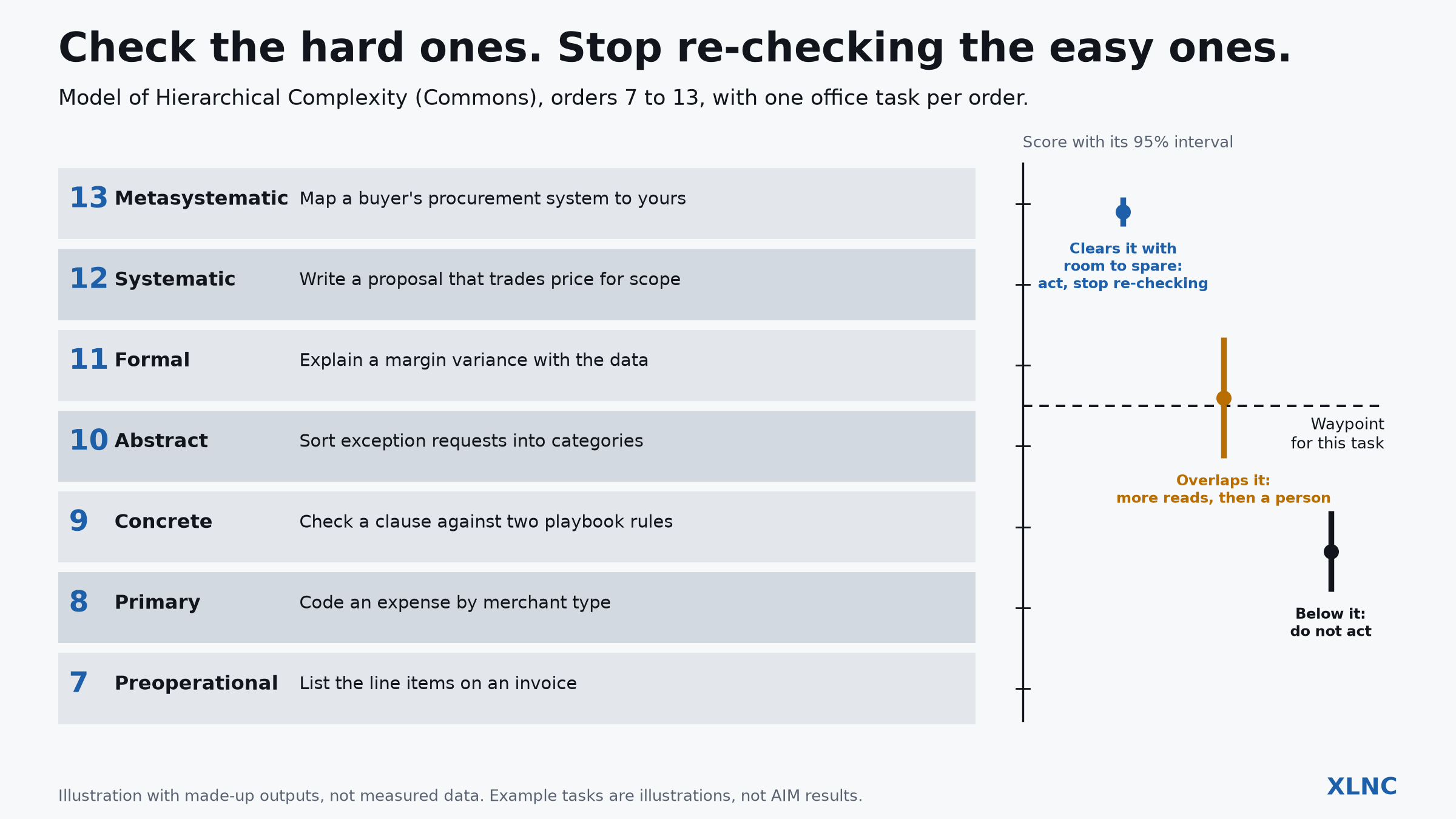
Illustration of the ruler and the decision rule, with made-up outputs, not measured data.
Karen Feigh studies how people work with automated decision support at Georgia Tech. She recently wrote about the cost of checking AI, which she calls the verification burden. One sentence in her piece explains why it costs so much: "When to stop verification is less obvious" (Feigh, 2026). Futurism picked it up under a blunt headline about AI errors erasing the gains (Wilkins, 2026).
You cannot stop checking well if every output looks the same to you. An expense code and a sales proposal both arrive as text from the same tool. One takes a clerk a glance to check. The other takes a senior person an afternoon. Most teams treat them alike because nothing on the output says which is which.
This post is about a ruler that does say which is which.
The bill shows up in several surveys
The numbers come from different samples and different questions, so do not add them up. Most are self-reported and several have vendor sponsors. They locate a cost to investigate, not a universal rate or proof that AI has no net gain.
- Workday surveyed 3,200 employees and leaders at large firms. Rework absorbed nearly 40% of the time AI saved, "including correcting errors, rewriting content, and verifying outputs" (Workday, 2026).
- Datarails surveyed 270 CFOs in July 2026. Finance teams spend 26% of the working week verifying or correcting AI output (Datarails, 2026).
- A Glean Work AI Institute survey of 6,000 digital workers found about 6.4 hours a week spent feeding context to AI tools and cleaning up after them (Plumb, 2026).
- A Harvard study of 718 firms found that as AI raised code output, average time to review a pull request rose 49% (De Simone, 2026).
Feigh is careful here. The studies "do not establish that there is a universal verification 'tax'" (Feigh, 2026). The size of the burden depends on the task. If the cost depends on the task, you need a way to say how hard each task is before you decide how hard to check it.
A published ruler of task complexity
Michael Commons of Harvard Medical School built the Model of Hierarchical Complexity, or MHC (Commons, 2008). It orders tasks by what they must coordinate, not by topic. A task sits one order higher only when it combines two or more actions from the order below and organizes them in a fixed, non-arbitrary way. More steps or more effort do not raise the order. The numbering here follows Commons and Kjorlien's current table, where order 8 is Primary and order 13 is Metasystematic (Commons & Kjorlien, 2016).
The office tasks in this post fall between order 7 and order 13. Here is that range with one office task per order, and what it takes to check an AI output at that order.
| MHC order | What the task coordinates | Example office task | What checking the AI output takes |
|---|---|---|---|
| 7 Preoperational | Lists and sequences, not yet a stable rule | List the line items on a vendor invoice, in order | Compare the list to the invoice. Anyone on the team can do it. |
| 8 Primary | One explicit rule, applied as a simple if-then | Code each expense to a ledger account by merchant type | Confirm the one rule. A small sample can settle a large batch. |
| 9 Concrete | Two or more different rules combined into one result | Check each contract clause against two playbook rules, the liability cap and the governing law, and count which rule fails more often | Apply both rules to each clause. Still a lookup, but twice per clause. |
| 10 Abstract | A named category formed from many comparisons | Sort 200 past policy exception requests into named categories, each with a boundary rule, then tag new requests | Test each boundary on edge cases. A reviewer must understand the policy. |
| 11 Formal | Two or more variables related in one evidence-based if-then rule | Explain a margin variance: freight cost per unit rises when orders fall below a certain size, shown with the data | Rerun the numbers and test whether the rule holds. An analyst's job. |
| 12 Systematic | Several rules coordinated into one joint system with tradeoffs | Write a sales proposal that sets price, scope, timeline and staffing together, so a change to one shows its effect on margin and delivery risk | Rebuild the tradeoffs to see whether they hold. A senior person's job. |
| 13 Metasystematic | Two or more whole systems compared and linked | Map the buyer's procurement scoring system against your own delivery system, show where they conflict, and choose a proposal structure that works under both | Few people on any team can check it, and each check is slow. |
The "what the task coordinates" column paraphrases Commons' definitions. The example tasks are illustrations, not measured AIM results.
Read the fourth column from top to bottom. The cost of a check rises with the order, and the pool of people who can do it shrinks.
Why a 1 to 5 judge score cannot do this
Many AI evaluations ask a model to grade an output from 1 to 5. That number cannot tell you where to stop checking, for three reasons that compound.
A 4 on an expense code and a 4 on a sales proposal do not mean the same thing. The scale has no fixed reference, so the number says nothing about how hard the task was.
A 4 from a harsh judge is not a 4 from a lenient one. Judges differ in severity, and the lean can shift with how hard the work is. A raw score carries the judge inside it.
The score comes with no uncertainty. You cannot tell a confident 4 from a lucky one.
So you check everything, or you guess.
What metrological traceability adds
Metrological traceability means a result can be related to a stated reference through a documented, unbroken chain of calibrations, each with its own uncertainty. Applied to AI output, the chain has three parts.
1. A stated reference. Each order has a published definition, and each boundary between orders has a calibrated location with its own uncertainty.
2. A measured judge. Each judge's severity is measured as its own facet, so it can be taken out of the score. That method has a medical history. Many-facet Rasch measurement was built in 1987 for a hands-on credentialing exam at the American Society of Clinical Pathologists, where examiners differed in how hard they graded (Stahl, 2015 and Linacre et al., 1990).
3. A score with its standard error of measurement, or SEM. The SEM describes how precise the score is under the model. It is not a probability that the output is factually correct.
With those parts in place, each output gets an order with an interval, and you read that interval against a Waypoint. Set the cut for each task from what a wrong call costs, and write the stopping rule down before the run.
- If the 95% interval sits wholly on the acceptable side of the cut, act on it and stop re-checking.
- If the interval sits wholly on the other side, do not act on it.
- If it overlaps the cut, take more reads within the budget you set. If it still overlaps, send it to a person who can check that order.
On a staged ruler, read the interval against the bands it falls in, not against one line alone.
The rule moves attention up the table. At orders 8 to 10, a check is cheap and many people can do it. Orders 11 to 13 are where the hard checks belong, and the experts who can do them stop spending time on expense codes.
What this does not solve
A narrow SEM cannot reveal a blind spot that every judge shares, a missing source or a systematic bias. Independent checks still matter. Low order does not mean low stakes. A wrong expense code in a regulated filing still needs a control.
AIM is built on this chain, and some links are still open. We are still checking how often the intervals hold against calibration data, and each report names its open links.
What you can do this week
1. Log checking time apart from generation time, by task. Feigh's test is "whether the entire human-AI workflow produces trustworthy work at a lower total cost" (Feigh, 2026). You cannot run it if checking time is invisible.
2. Place your five most common AI tasks on the table above. Ask what each one must coordinate, and pick the highest row whose test it must pass to be done right.
3. Write down what a miss costs and what a false alarm costs for each task. That pair sets the cut.
4. Watch where your experts spend their checking time. If much of it goes to order 8 work, that is time you can move up the table.
If your team checks AI output at several of these orders, I would like to hear how you decide what to check and when to stop.
References
- Commons, M. L. (2008). Introduction to the model of hierarchical complexity and its relationship to postformal action. World Futures, 64(5-7), 305-320. https://doi.org/10.1080/02604020802301105
- Commons, M. L., & Kjorlien, O. A. (2016). The meta-cross-paradigmatic order and stage 16. Behavioral Development Bulletin, 21(2), 154-164. https://doi.org/10.1037/bdb0000037
- Datarails. (2026, October 6). Finance teams now spend a quarter of their week fact-checking AI, new Datarails survey finds. https://www.datarails.com/blog/cfo-survey-ai-finance/
- De Simone, S. (2026, October 22). Study finds AI-generated code fails to boost productivity due to downstream bottlenecks. InfoQ. https://infoq.com/news/2026/10/jellyfish-ai-productivity
- Feigh, K. (2026, November 16). Catching AI's mistakes is a mental burden, and a drag on productivity. The Conversation. https://theconversation.com/catching-ais-mistakes-is-a-mental-burden-and-a-drag-on-productivity-291748
- Linacre, J. M., Wright, B. D., & Lunz, M. E. (1990). A facets model for judgmental scoring (MESA Memo 61). MESA Psychometric Laboratory, University of Chicago. https://rasch.org/memo61.htm
- Plumb, T. (2026, June 10). The hidden cost of enterprise AI: 6.4 hours a week babysitting bots. CIO. https://www.cio.com/article/4183804/the-hidden-cost-of-enterprise-ai-6-4-hours-a-week-babysitting-bots.html
- Stahl, J. (2015). Working with Ben to solve tough practical problems. Rasch Measurement Transactions, 29(3), 1531-1532. https://www.rasch.org/rmt/rmt293.pdf
- Wilkins, J. (2026, November 21). AI is still so riddled with errors that it's erasing any productivity gains that would make it useful in the workplace. Futurism. https://futurism.com/future-society/ai-errors-productivity-verification-burden-useful
- Workday. (2026, January 14). New Workday research: Companies are leaving AI gains on the table. https://investor.workday.com/news-and-events/press-releases/news-details/2026/New-Workday-Research-Companies-Are-Leaving-AI-Gains-on-the-Table/default.aspx