Two learners, one score: Vygotsky's zone and the ruler it needs
Vygotsky's zone of proximal development is the gap between unaided and assisted performance. Developmental psychology has long established a modern form of that idea. AI training now aims at the gap, and it needs a calibrated ruler with metrological traceability to find it.
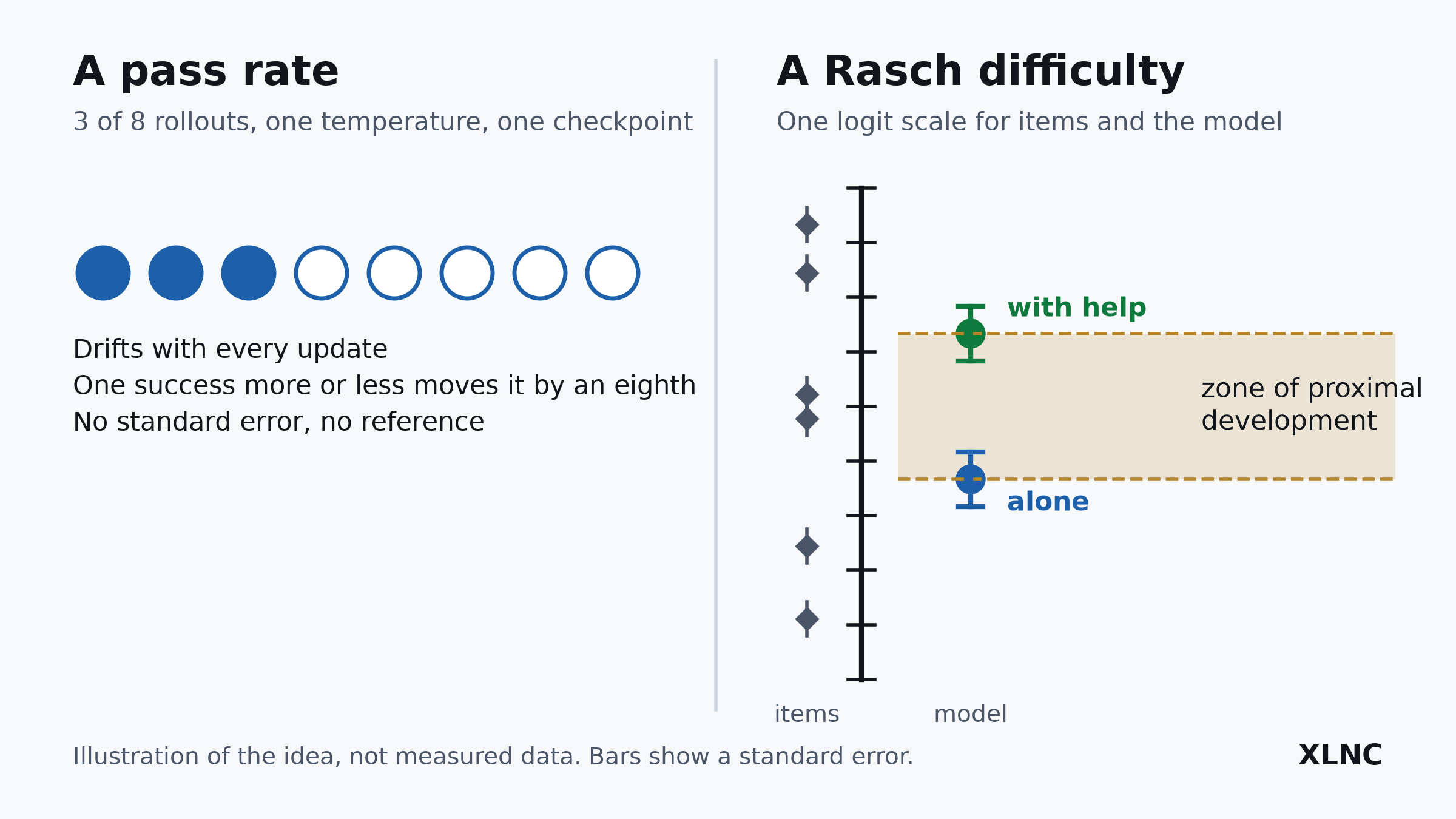
Illustration of the idea, not measured data.
Two learners get the same score on a test they take alone. Are they at the same place?
Lev Vygotsky said no. His example was two children with the same unaided level. With help, one of them reaches much further than the other. He called that gap the zone of proximal development. It is the distance between what a learner does alone and what the same learner does with guidance or with a more capable partner (Vygotsky, 1978). Many English readers met the idea through Mind in Society, a 1978 collection edited by Michael Cole and colleagues.
The zone is a difference: assisted performance minus unaided performance, relative to the person and to the support. People often call that useful stretch the Goldilocks zone, work that is not too hard and not too easy. The intuition is close, and the difference has to stay in view. The zone is not a fixed band on a difficulty scale, and it is not a property of a task alone.
Developmental psychology has long established a modern form of the idea. The model of hierarchical complexity gives each task an order of hierarchical complexity. A person's stage is the highest order of successful performance (Commons et al., 1998). A practical reading is to pitch the next task at the next order. That heuristic comes from the order of the task, not from a second definition of the zone.
Dynamic skill theory separates a functional level from an optimal level. The functional level is what a person produces unaided in ordinary conditions. The optimal level is what the same person produces under high support. The span is the developmental range, as Fischer (1980), Fischer and Bidell (2006), and Kitchener and colleagues (1993) describe. Wood, Bruner, and Ross (1976) called the tutoring process in that span scaffolding. Scaffolding is the mechanism, not a synonym for the zone.
As Chaiklin (2003) reads Vygotsky, teaching should aim at abilities that are maturing, rather than at those already in place. The zone diagnoses those maturing abilities.
Language models keep rediscovering the gap
Cognitive science has close relatives of the idea. Metcalfe and Kornell (2005) described a region of proximal learning for how people choose what to study. Oudeyer and colleagues (2007) proposed learning progress as the drive for intrinsically motivated machines. Clément and colleagues (2024) took a zone-based tutoring algorithm, ZPDES, into a randomized trial with 265 children aged 7 to 8.
Language model research then located the gap directly. Cui and Sachan (2025) located a model's zone item by item. They compared each answer with and without in-context examples, then fit an item response model to predict the zone. They used it to choose when examples help and to build a fine-tuning curriculum. Salhan and colleagues (2025) aimed "teacher demonstrations" at a small model's zone to improve dialogue that stays contingent across turns. Our earlier post, The Network That Learned Like a Child, made the matching case. "Alone" and "with help" must sit on one scale, each with its uncertainty.
Curriculum work followed. Zhang and colleagues (2025) re-estimate difficulty as it shifts during training, and they guide the model to reformulate expert solutions. Chen and colleagues (2025) treat curriculum choice as a non-stationary bandit, with absolute advantage as a proxy for learning gain. He and colleagues (2026) cap each step up in difficulty with a ZPD threshold when they distill knowledge into a smaller model.
Kong and colleagues (2025) sample problems by aligning model competence with problem difficulty. Guo and colleagues (2025) let an environment simulator co-evolve with an agent at matched difficulty. They report gains of up to +40.3% over 7B baselines. McKenzie and colleagues (2026) add a warning: difficulty alone is not enough to choose what to train on.
Other work applies the idea to how models judge learners and how people learn with models. Dong and colleagues (2025) built a benchmark that asks models to judge reading difficulty against a student's stage. Beale (2025) reviews how Vygotsky, the Socratic method and Laurillard's work apply to conversational AI.
Wallis (2026) offers a theory-only account of language models and the zone. dos Santos and Birdwell (2025) warn that help which never stops can replace the struggle that learning needs.
What reinforcement learning adds
Reinforcement learning with verifiable rewards gives converging evidence. GRPO, introduced with DeepSeekMath (Shao et al., 2024), samples a group of answers to each prompt and scores each one with a checker. Each answer's advantage is its reward minus the group mean, divided by the group standard deviation.
If every answer in a group gets the same reward, the standard deviation is zero and no learning signal remains. Take an illustrative case with eight answers per prompt. At a pass rate of 0.5, all eight agree about 0.8% of the time. At a pass rate of 0.125, all eight fail about 34% of the time. When one answer of eight succeeds, it gets an advantage of about +2.65, and each failure gets about -0.38 (population standard deviation).
So the gradient survives best in the middle band. DAPO over-samples and drops prompts where every answer is right or every answer is wrong (Yu et al., 2025). Goldilocks RL trains a selector to predict each question's reward spread (Mahrooghi et al., 2026). MagicBeanStalk labels 0 of 8 as hard, 1 to 7 of 8 as the Goldilocks band, and 8 of 8 as stale or mastered. In one pooled corpus it found about 88% of prompts in the zero-advantage trap (Lu et al., 2026).
Liu and colleagues (2025) add a twist. Dividing by the standard deviation gives more weight to questions that are too easy and to questions that are too hard.
The limits
This evidence has limits. A peak near a pass rate of 0.5 is a property of the estimator, not evidence for the zone. The band is about gradient survival, not understanding. Difficulty filtering without scaffolding is competence matching, not the zone in Vygotsky's sense, because help sets the zone's upper edge. All of it is evidence about training efficacy, not measurement validity.
Fischer (1980) and Kitchener and colleagues (1993) describe that range. Whether it widens at higher levels is a hypothesis to test, not a finding.
A pass rate is not a difficulty
DAPO and MagicBeanStalk sort prompts by pass rate, as if a pass rate were a good enough difficulty number. "3 of 8" is a frequency from eight rollouts, at one temperature, on one checkpoint. It drifts with every update. One success more or less moves the rate by one eighth. It carries no standard error and no reference.
A Rasch difficulty is a different kind of number. It is a calibrated parameter with a standard error. It sits on one logit scale with model ability, and the two parameters stay separate. That separation matters because difficulty is model-relative and shifts as a model trains (Zhang et al., 2025).
That gap is the case for metrological traceability. A result has metrological traceability when it can be related to a reference through a documented unbroken chain of calibrations. Each step contributes to the measurement uncertainty. That is entry 2.41 of the International Vocabulary of Metrology (JCGM, 2012). Mari and colleagues (2023) set the same idea in a shared concept system for measurement across the sciences.
A change in a model then becomes a move along one ruler, not a difference between two instruments. Unaided performance and assisted performance become two measurements on one ruler. The width of the developmental range becomes a measured quantity with a standard error. The order of a task and the difficulty of an item can sit on that same scale.
Improvement then follows a short loop. Locate the system. Aim practice at the edge of the band, and do the same with curricula and with items. Keep anchors above and below it. Measure again on the same ruler. One more rule keeps the loop honest: fixed item sets leak, so fresh items go on the calibrated scale before they count.
What we are building
XLNC builds AIM for the measurement and evaluation of people and models on one scale, with a standard error on every measure. This post reports no results from our own instruments. We plan a hosted AIM API and MCP server. Neither is available yet.
Vygotsky asked what a learner can do with help. Training pipelines now ask a version of that question about models at every update. The answer is only as useful as the ruler you read it on.
If you train or evaluate models, how do you decide that a prompt sits at the edge? Tell us on X at @XLNC_CO or through the form at xlnc.co.
References
- Beale, R. (2025). Dialogic pedagogy for large language models: Aligning conversational AI with proven theories of learning (arXiv:2506.19484). arXiv. https://doi.org/10.48550/arXiv.2506.19484
- Chaiklin, S. (2003). The zone of proximal development in Vygotsky's analysis of learning and instruction. In A. Kozulin, B. Gindis, V. S. Ageyev, & S. M. Miller (Eds.), Vygotsky's educational theory in cultural context (pp. 39-64). Cambridge University Press. https://doi.org/10.1017/CBO9780511840975.004
- Chen, X., Lu, J., Kim, M., Zhang, D., Tang, J., Piché, A., Gontier, N., Bengio, Y., & Kamalloo, E. (2025). Self-evolving curriculum for LLM reasoning (arXiv:2505.14970). arXiv. https://doi.org/10.48550/arXiv.2505.14970
- Clément, B., Sauzéon, H., Roy, D., & Oudeyer, P.-Y. (2024). Improved performances and motivation in intelligent tutoring systems: Combining machine learning and learner choice (arXiv:2402.01669). arXiv. https://doi.org/10.48550/arXiv.2402.01669
- Commons, M. L., Trudeau, E. J., Stein, S. A., Richards, F. A., & Krause, S. R. (1998). Hierarchical complexity of tasks shows the existence of developmental stages. Developmental Review, 18(3), 237-278. https://doi.org/10.1006/drev.1998.0467
- Cui, P., & Sachan, M. (2025). Investigating the zone of proximal development of language models for in-context learning. In Findings of the Association for Computational Linguistics: NAACL 2025 (pp. 6470-6483). Association for Computational Linguistics. https://doi.org/10.18653/v1/2025.findings-naacl.362
- Dong, W., Sun, Z., Zhao, Y., Peng, Z., Wu, J., Zheng, J., Liu, Y., He, X., Wang, Y., Wang, R., Huang, X., & Mo, L. (2025). ZPD-SCA: Unveiling the blind spots of LLMs in assessing students' cognitive abilities (arXiv:2508.14377). arXiv. https://doi.org/10.48550/arXiv.2508.14377
- dos Santos, E. C., Jr., & Birdwell, T. (2025). The unspoken crisis of learning: The surging zone of no development (arXiv:2511.12822). arXiv. https://doi.org/10.48550/arXiv.2511.12822
- Fischer, K. W. (1980). A theory of cognitive development: The control and construction of hierarchies of skills. Psychological Review, 87(6), 477-531. https://doi.org/10.1037/0033-295X.87.6.477
- Fischer, K. W., & Bidell, T. R. (2006). Dynamic development of action and thought. In R. M. Lerner (Ed.), Handbook of child psychology: Vol. 1. Theoretical models of human development (6th ed., pp. 313-399). John Wiley & Sons. https://doi.org/10.1002/9780470147658.chpsy0107
- Guo, J., Yang, L., Chen, P., Xiao, Q., Wang, Y., Juan, X., Qiu, J., Shen, K., & Wang, M. (2025). GenEnv: Difficulty-aligned co-evolution between LLM agents and environment simulators (arXiv:2512.19682). arXiv. https://doi.org/10.48550/arXiv.2512.19682
- He, B., Chen, Y., Zhang, X., Kong, L., Yu, P. S., Liu, X., & Ma, C. (2026). Pedagogically-inspired data synthesis for language model knowledge distillation (arXiv:2602.12172). arXiv. https://doi.org/10.48550/arXiv.2602.12172
- JCGM. (2012). International vocabulary of metrology: Basic and general concepts and associated terms (VIM) (3rd ed., JCGM 200:2012). Joint Committee for Guides in Metrology. https://www.bipm.org/documents/20126/2071204/JCGM_200_2012.pdf
- Kitchener, K. S., Lynch, C. L., Fischer, K. W., & Wood, P. K. (1993). Developmental range of reflective judgment: The effect of contextual support and practice on developmental stage. Developmental Psychology, 29(5), 893-906. https://doi.org/10.1037/0012-1649.29.5.893
- Kong, D., Guo, Q., Xi, X., Wang, W., Wang, J., Cai, X., Zhang, S., & Ye, W. (2025). Rethinking the sampling criteria in reinforcement learning for LLM reasoning: A competence-difficulty alignment perspective (arXiv:2505.17652). arXiv. https://doi.org/10.48550/arXiv.2505.17652
- Liu, Z., Chen, C., Li, W., Qi, P., Pang, T., Du, C., Lee, W. S., & Lin, M. (2025). Understanding R1-Zero-like training: A critical perspective (arXiv:2503.20783). arXiv. https://doi.org/10.48550/arXiv.2503.20783
- Lu, X., Kumar, A., Kautz, J., Choi, Y., & Acuna, D. (2026). MagicBeanStalk: Escaping the RLVR zero advantage trap with recursive data synthesis (arXiv:2610.12659). arXiv. https://doi.org/10.48550/arXiv.2610.12659
- Mahrooghi, I., Lotfi, A., & Abbe, E. (2026). Goldilocks RL: Tuning task difficulty to escape sparse rewards for reasoning (arXiv:2602.14868). arXiv. https://doi.org/10.48550/arXiv.2602.14868
- Mari, L., Wilson, M., & Maul, A. (2023). Measurement across the sciences: Developing a shared concept system for measurement (2nd ed.). Springer. https://doi.org/10.1007/978-3-031-22448-5
- McKenzie, D., Hansen, N., & Wang, X. (2026). Manifold bandits: Bayesian curriculum learning over the latent geometry of large language models (arXiv:2606.19750). arXiv. https://doi.org/10.48550/arXiv.2606.19750
- Metcalfe, J., & Kornell, N. (2005). A region of proximal learning model of study time allocation. Journal of Memory and Language, 52(4), 463-477. https://doi.org/10.1016/j.jml.2004.12.001
- Oudeyer, P.-Y., Kaplan, F., & Hafner, V. V. (2007). Intrinsic motivation systems for autonomous mental development. IEEE Transactions on Evolutionary Computation, 11(2), 265-286. https://doi.org/10.1109/TEVC.2006.890271
- Salhan, S., Gu, H., Rooein, D., Galvan-Sosa, D., Gaudeau, G., Caines, A., Yuan, Z., & Buttery, P. (2025). Teacher demonstrations in a BabyLM's zone of proximal development for contingent multi-turn interaction (arXiv:2510.20411). arXiv. https://doi.org/10.48550/arXiv.2510.20411
- Shao, Z., Wang, P., Zhu, Q., Xu, R., Song, J., Bi, X., Zhang, H., Zhang, M., Li, Y. K., Wu, Y., & Guo, D. (2024). DeepSeekMath: Pushing the limits of mathematical reasoning in open language models (arXiv:2402.03300). arXiv. https://doi.org/10.48550/arXiv.2402.03300
- Vygotsky, L. S. (1978). Mind in society: The development of higher psychological processes (M. Cole, V. John-Steiner, S. Scribner, & E. Souberman, Eds.). Harvard University Press. https://doi.org/10.2307/j.ctvjf9vz4
- Wallis, P. (2026). LLMs and the ZPD (arXiv:2605.12016). arXiv. https://doi.org/10.48550/arXiv.2605.12016
- Wood, D., Bruner, J. S., & Ross, G. (1976). The role of tutoring in problem solving. Journal of Child Psychology and Psychiatry, 17(2), 89-100. https://doi.org/10.1111/j.1469-7610.1976.tb00381.x
- Yu, Q., Zhang, Z., Zhu, R., Yuan, Y., Zuo, X., Yue, Y., Dai, W., Fan, T., Liu, G., Liu, L., Liu, X., Lin, H., Lin, Z., Ma, B., Sheng, G., Tong, Y., Zhang, C., Zhang, M., Zhang, W., . . . Wang, M. (2025). DAPO: An open-source LLM reinforcement learning system at scale (arXiv:2503.14476). arXiv. https://doi.org/10.48550/arXiv.2503.14476
- Zhang, E., Yan, X., Lin, W., Zhang, T., & Lu, Q. (2025). Learning like humans: Advancing LLM reasoning capabilities via adaptive difficulty curriculum learning and expert-guided self-reformulation (arXiv:2505.08364). arXiv. https://doi.org/10.48550/arXiv.2505.08364