A Container Answers Where AIM Runs. You Still Own the Data and the Decision.
We plan for AIM to run inside your own cloud. That can settle where the software runs and who reaches it. Data quality and accountability stay with you.
Your team picks an AI tool it likes. Then IT asks where the data goes and who can reach the system, and the project stops. Meanwhile, the decisions it should check go out with no measurement. That gap is the cost of doing nothing, and it lasts as long as the IT question stays open.
A container is the usual answer to that question. It answers part of the problem well. Two other parts stay with you, and they should.
What the container answers
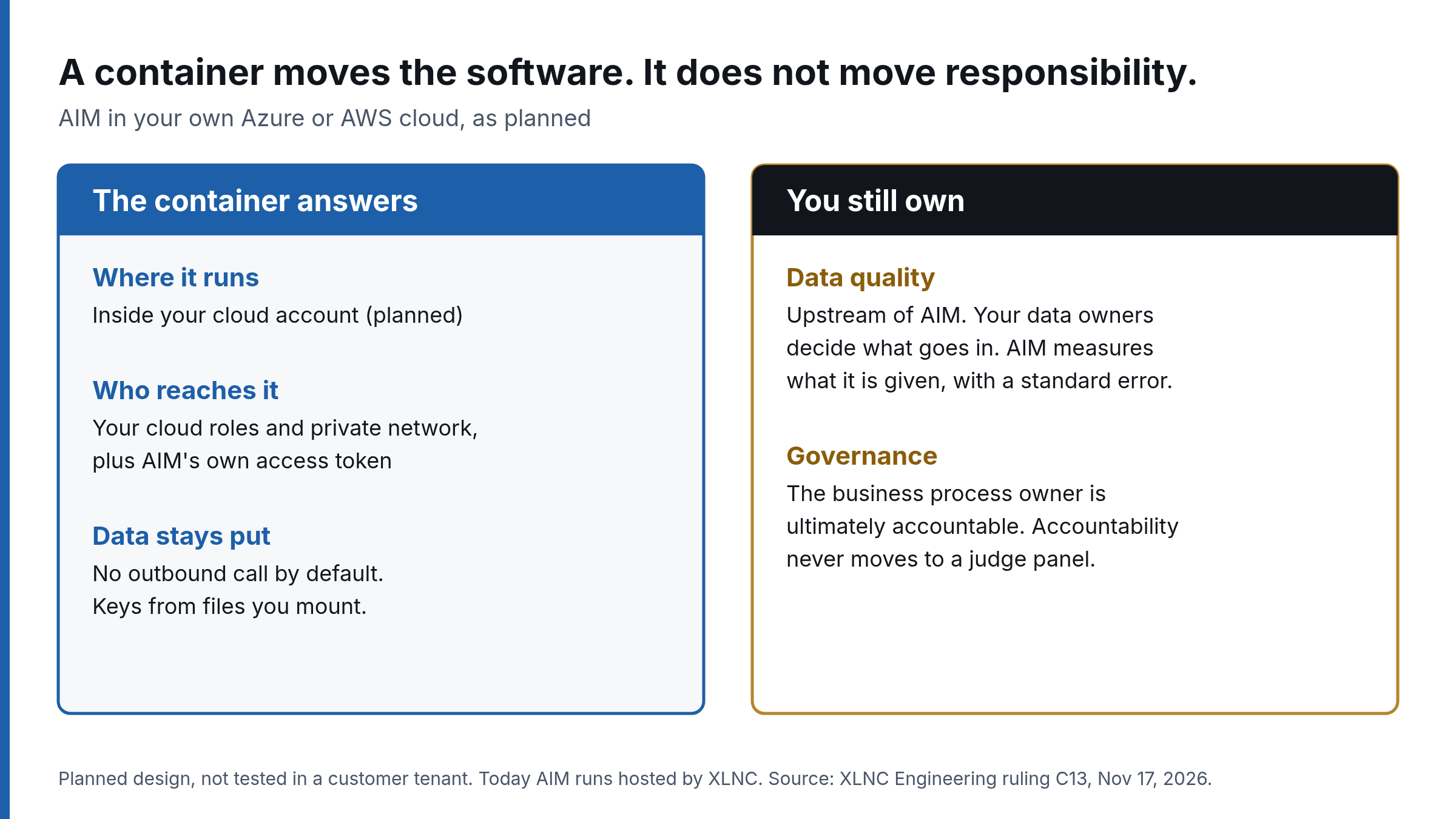
We plan for AIM to run as a Docker container inside your own Azure or AWS cloud. Today AIM runs hosted by XLNC, and no customer-run container exists yet. The design answers three IT questions.
- Where does it run? Inside your own cloud account.
- Who can reach it? Your cloud roles decide who can deploy, change or read it. Your private network keeps callers inside. AIM also checks its own access token.
- Does our data leave? AIM makes no outbound call by default. It reads its keys from files you mount, and your platform can collect its logs.
We did not test this setup in a customer tenant yet. Our FAQ lists which parts we designed and which parts we did not build yet.
What you still own
A container moves the software. Your data and your decisions stay where they were.
Data quality is upstream. Your data owners decide what goes in. AIM measures what you give it. AIM does not judge whether your data is accurate, and it does not correct wrong values. AIM refuses the whole file if it cannot read it, and it gives the reason. AIM sets aside a row with a missing field or a score out of range, and it refuses the whole file if too many rows fail. A row that passes these checks still gets a score, even when its content is wrong.
Each score comes with its standard error, which states how precise the measurement is. A small standard error means a precise measurement. It does not mean the input was correct. If your data needs a check, run that check before AIM.
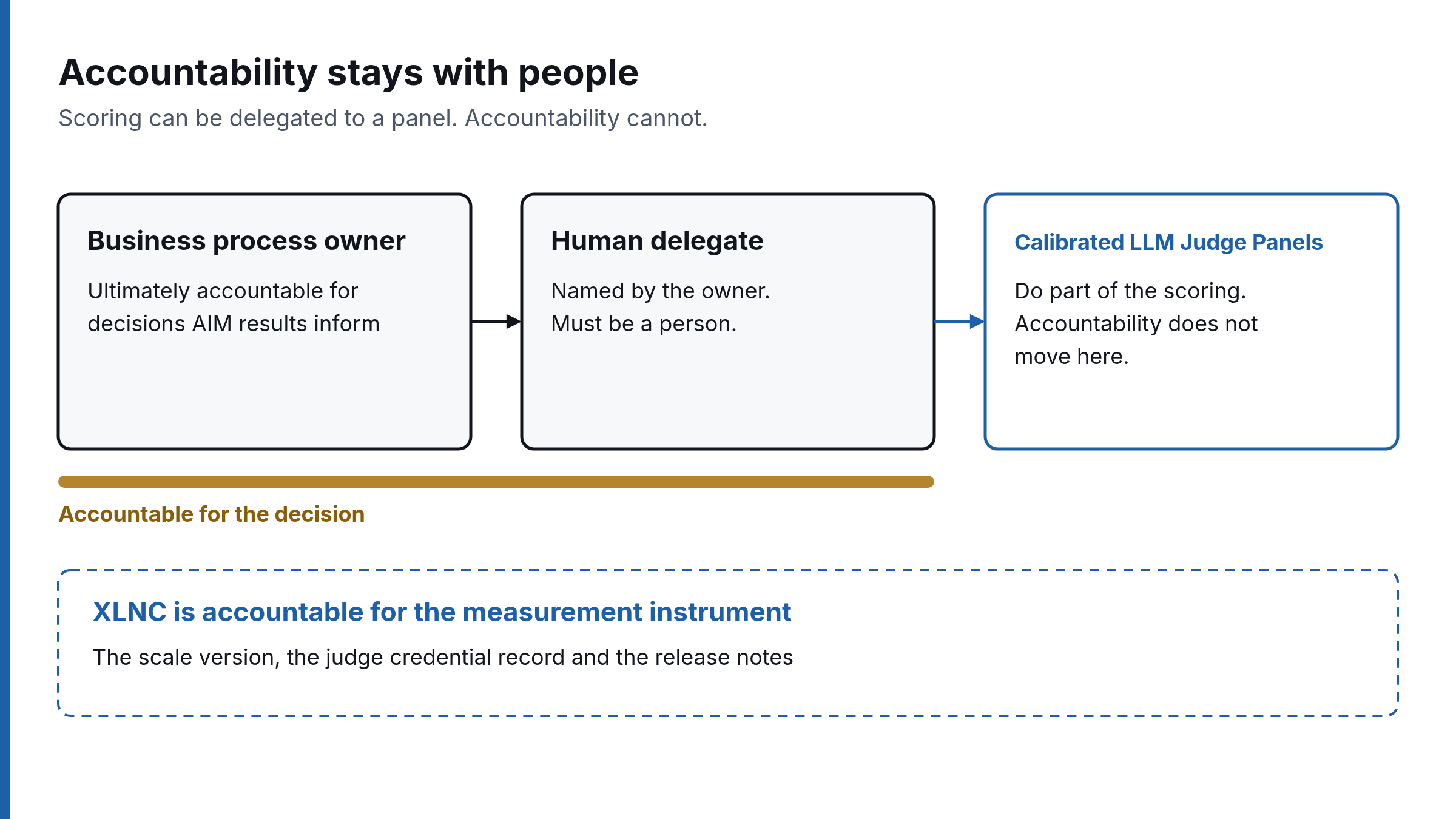
Governance stays with a person. The business process owner is ultimately accountable for the decisions that AIM results inform. The owner can delegate this work to another person, who must be a human. That delegate may hand part of the scoring to Calibrated LLM Judge Panels. Accountability never moves to a panel.
XLNC is accountable for the measurement instrument: the scale version, the judge credential record and the release notes.
How this splits by product
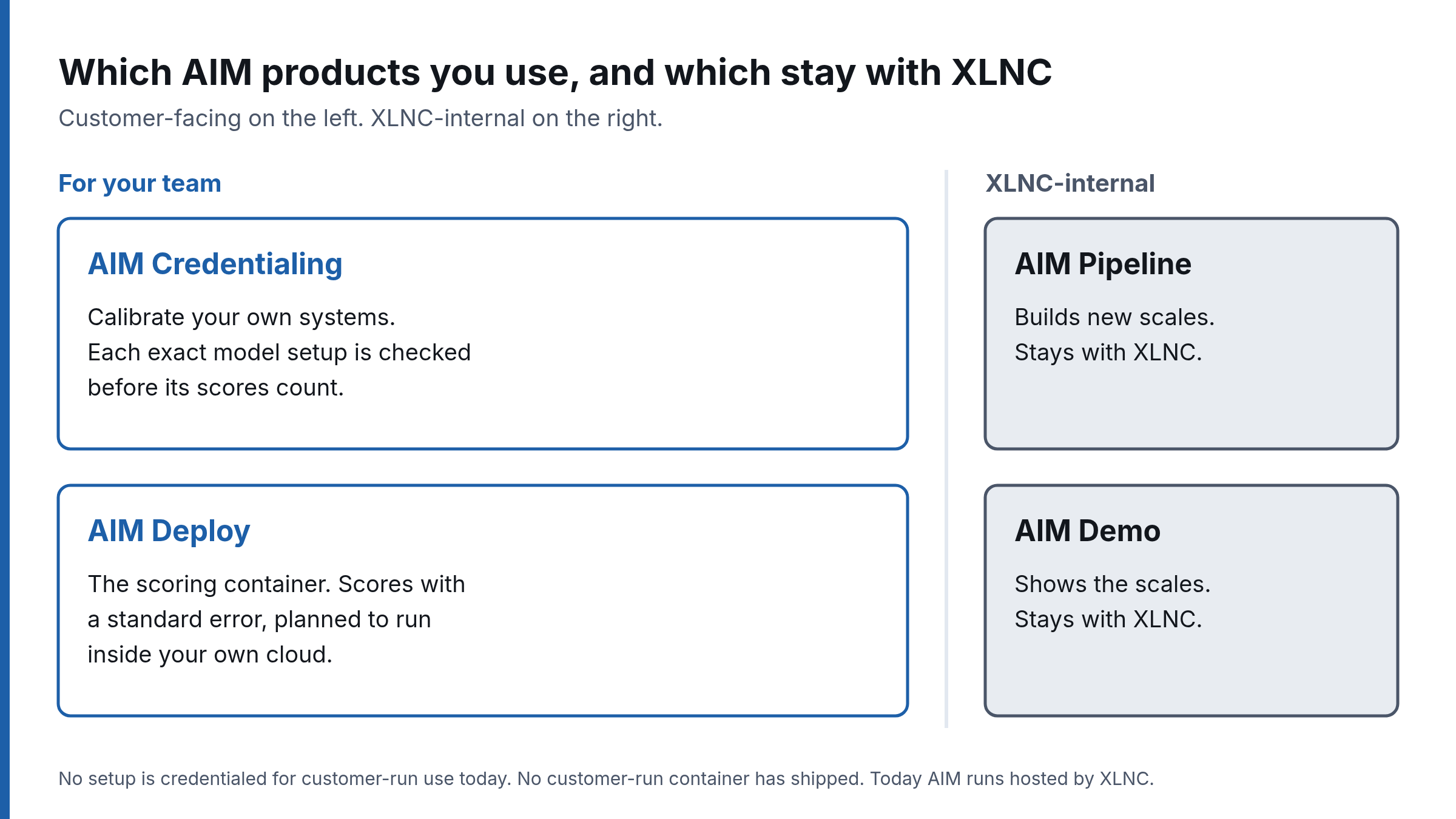
AIM Credentialing checks whether the LLMs you plan to use as judges are fit for your use case, so you can calibrate your own systems. Each exact model setup gets a credential check before its scores count on the AIM scale. A credential covers one setup on one host. If you host your own judges, their scores count only when at least two judges from two different model families each match a credentialed XLNC setup exactly, and three families for complexity levels 10 to 12. Today no setup holds a credential for customer-run use.
AIM Deploy is the scoring container. It reports each score with its standard error. This is the part we plan to run inside your cloud.
AIM Pipeline and AIM Demo stay with XLNC. Pipeline is how we build new scales. Demo is how we show them. Neither runs in your environment.
One question for your IT team
Ask them one question. "If AIM ran inside our own cloud, under our own access and logging, what would you still ask for?" The answer tells you which asks the container can settle and which ones belong to your data owners and your process owner.
Want to see how we measure the judges themselves? Join the Maven Lightning Lesson, Advanced AI Evaluation: Beyond Pass Rates, on Jan 7, 2027, at 9 AM ET.